Saltar al contenido principal
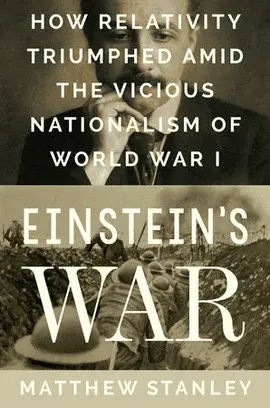
Einsteins War

Einsteins War

Matthew Stanley

"Stanley is a storyteller par excellence."--The Washington PostKirkus Review starred review; Publishers Weekly starred review; Booklist starred reviewThe birth of a world-changing idea in the middle of a bloodbathEinstein's War is a riveting exploration of both the beauty of scientific creativity and enduring horrors of human nature. These two great forces battle in a story tha...

Editorial:
Knopf
Materia:
Ciencia - STEM
ISBN:
978-1-5247-4541-7
Q. 260
IVA incluido
No disponible
Añadir a favoritos Avisar disponibilidad

Sinopsis

"Stanley is a storyteller par excellence."--The Washington Post
Kirkus Review starred review; Publishers Weekly starred review; Booklist starred review

The birth of a world-changing idea in the middle of a bloodbath
Einstein's War is a riveting exploration of both the beauty of scientific creativity and enduring horrors of human nature. These two great forces battle in a story that culminates with a victory now a century old, the mind-bending theory of general relativity.

Few recognize how the Great War, the industrialized slaughter that bled Europe from 1914 to 1918, shaped Einstein's life and work. While Einstein never held a rifle, he formulated general relativity blockaded in Berlin, literally starving. He lost fifty pounds in three months, unable to communicate with his most important colleagues. Some of those colleagues fought against rabid nationalism; others were busy inventing chemical warfare—being a scientist trapped you in the power plays of empire. Meanwhile, Einstein struggled to craft relativity and persuade the world that it was correct. This was, after all, the first complete revision of our conception of the universe since Isaac Newton, and its victory was far from sure.

Scientists seeking to confirm Einstein's ideas were arrested as spies. Technical journals were banned as enemy propaganda. Colleagues died in the trenches. Einstein was separated from his most crucial ally by barbed wire and U-boats. This ally was the Quaker astronomer and Cambridge don A. S. Eddington, who would go on to convince the world of the truth of relativity and the greatness of Einstein.

In May of 1919, when Europe was still in chaos from the war, Eddington led a globe-spanning expedition to catch a fleeting solar eclipse for a rare opportunity to confirm Einstein's bold prediction that light has weight. It was the result of this expedition—the proof of relativity, as many saw it—that put Einstein on front pages around the world. Matthew Stanley's epic tale is a celebration of how bigotry and nationalism can be defeated and of what science can offer when they are.

Artículos relacionados

El Pulgar del Violinista

El Pulgar del Violinista

Kean, Sam

Del autor del best seller internacional La cuchara menguante, este libro nos descubre los secretos que esconde nuestro código genético, y cómo su inminente decodificación está a punto de resolver cuestiones que llevamos siglos planteándonos.Paganini fue un violinista con un don tan grande que toda su vida tuvo que despejar los rumores de que había vendido su alma al diablo. Sin...

Disponible

Q. 220

El Viaje Cósmico de Merlín

El Viaje Cósmico de Merlín

Degrasse Tyson, Neil

El autor del bestseller Astrofísica para gente con prisa lleva ahora a los lectores a un entretenido y edificante recorrido por el universo.En este maravilloso viaje por el cosmos, Neil deGrasse Tyson, a través de un personaje legendario como el mago Merlín, responde a preguntas populares que le han formulado tanto niños como adultos. Merlín, un visitante atemporal del planeta ...

Disponible

Q. 180

Si Einstein lo Hubiera Sabido

Si Einstein lo Hubiera Sabido

Aspect, Alain

Dios sí juega a los dados con el universo: el ganador del Nobel de Física en 2022 reúne un siglo de debates y avances científicos. Este libro presenta el trabajo por el cual Alain Aspect se ganó el título de «pionero de la segunda revolución cuántica». Es también el resultado de su fascinación por la historia de la física del último siglo, que aquí nos narra en un recorrido des...

Disponible

Q. 295

Agujeros Negros

Agujeros Negros

Riazuelo, Alain

Tras el nombre de agujeros negros, que alimenta el imaginario colectivo, se esconden cuerpos celestes conceptualmente muy simples y, al mismo tiempo, muy difíciles de estudiar. Simples por definición: son objetos capaces de atrapar la luz en su interior. Difíciles, por un lado, porque son el escenario de fenómenos gravitacionales extremos, y por otro, porque, p...

Disponible

Q. 260

La Ilusión del Tiempo

La Ilusión del Tiempo

Casas, Alberto

¿ES EL PASO DEL TIEMPO ALGO REAL... O ES UNA ILUSIÓN? El investigador y divulgador de referencia en física cuántica nos adentra en el misterio más fascinante de la ciencia. MÁS DE 10.000 LECTORES. «En cada parada de ese itinerario se despliegan respuestas y preguntas sobre cuestiones fundamentales de la existencia cotidiana». El País «Hay científicos capaces de conducirnos en u...

Disponible

Q. 260

Un Trip de Ciencia Psicodélica

Un Trip de Ciencia Psicodélica

Ortiz Medrano, Alejandra

Quizá últimamente hayas escuchado hablar de rituales con veneno de sapo, retiros de ayahuasca o terapias con psilocibina, y seguro ese mundo ha despertado tu curiosidad. Sentir atracción o rechazo por él es fácil; pero navegar de manera segura en el mar de información sobre los psicodélicos resulta más complejo, porque, entre noticias o experiencias ajenas, ¿a quién creerle? Y ...

Disponible

Q. 170