Saltar al contenido principal
Ancient Mayan Message: Dresden Codex Facsimile

Ancient Mayan Message: Dresden Codex Facsimile

Najarro, Olga Judith

Ancient Mayan Message (Dresden Codex facsimile) This third edition features a full-color reproduction of The Dresden Codex that has been carefully crafted by the author Olga Judith Najarro Ibarra, to re-create the original Mayan manuscript, an archaeological and historical treasure. This facsimile should benefit in the research, study and consultation of this mysterious Mayan h...

Editorial:
Createspace
Materia:
Estudios mayas
ISBN:
978-1-5425-6490-8
Encuadernación:
OTROS
Q. 250
IVA incluido
No disponible
Añadir a favoritos Avisar disponibilidad

Sinopsis

Ancient Mayan Message (Dresden Codex facsimile) This third edition features a full-color reproduction of The Dresden Codex that has been carefully crafted by the author Olga Judith Najarro Ibarra, to re-create the original Mayan manuscript, an archaeological and historical treasure. This facsimile should benefit in the research, study and consultation of this mysterious Mayan hieroglyphic writing. Ms. Judith Najarro has dedicated many years to hand-drawing and coloring the intricate blends of minute details that encompass the complex and fascinating Mayan hieroglyphic writing in order to ensure precision, accuracy of proportions, levels and orientation to her excellent art work that contains 78 plates, except four of them that are completely blurry. This exciting new edition is based on a comparison between several pre-WWII facsimiles of The Dresden Codex, when the codex was in better conditions. The original manuscript is still in fair shape, but several plates have suffered damage from bombings, fires, floods, mildew etc., and now are blurry; also, the plates are no longer connected in quite the same way. Originally, all of the plates were attached to each other forming a single strip of some 3.5 meters long when stretched out from their accordion folds. The original sequence of the plates were: pages 1-24 followed by 46-74, followed by 25-45. According to some historians the original manuscript was found in one of the largest Mayan cities and was supposedly sent to Europe around 1519. In 1744, it was acquired by The Royal Library of Dresden Germany, to which it owes its name. Many researchers agree that The Codex deals with: Astronomy, mathematics, astrological tables of the planets, the moon, conjunctions of solar bodies, cosmogonic theories, religion, agriculture, magic and mythology. The Mayas used tree bark for the preparation of their papyrus on which they drew and painted their colored hieroglyphs and pictures, as the highest expression of their knowledge and pictographic art. The Dresden Codex (Dresdensis Codex) is without a doubt, the most important pre-Hispanic document that has been preserved throughout the centuries. It is the oldest known book written in the Americas; of the hundreds of books that were used in Meso-America before the Spanish conquest, it is one of only 15 that have survived to the present day. This third edition facsimile elaborated by Judith Najarro, is a perfect replica of The Dresden Codex, and should inspire scientists, archaeologists, astronomers, mathematicians, historians, native peoples and the world at-large to explore into the secrets of the past and the universe.

Artículos relacionados

Popol Wuj

Popol Wuj

Anonimo / Rodríguez Guaján, Pakal B Alam (Adaptador)

Popol wuj, libro del Pueblo, Libro del Consejo. Es conocido como Popol wuj. La academia de las Lenguas Mayas de Guatemala, y de la Reforma Educativa, han hecho posible difundir el Popol wuj, como forma correcta. El popol Wuj es uno de los textos más importantes de la literatura maya. Incluye historias y mitología de la creación del mundo. Contiene un conjunto de conceptos, cree...

Disponible

Q. 55

Las Religiones Indígenas de Mesoamérica. Historia, Ritos y Transformaciones

Las Religiones Indígenas de Mesoamérica. Historia, Ritos y Transformaciones

Neurath, Johannes

Este libro ofrece una introducción general a las religiones de Mesoamérica. No persigue un fin enciclopedista, sino demostrar que, aun en la época de la hiperespecialización académica, los estudios mesoamericanos integrales no son imposibles. Un aporte fundamental de esta nueva propuesta es impulsar conceptos que no provienen de la teología y de la historia de las religiones, s...

Disponible

Q. 150

Listening To Ceramics. Understanding The Prehispanic Cultural Development Of The South Coast And Highlands Of Guatemala

Listening To Ceramics. Understanding The Prehispanic Cultural Development Of The South Coast And Highlands Of Guatemala

Marion Popenoe De Hatch

Doctor Marion Popenoe de Hatch is a Guatemalan-American archaeologist who has worked tirelessly to reconstruct an important part of Guatemala's prehispanic history. This book is the culmination of over 45 years of her research at many sites in Guatemala's Highlands and South Coast, particularly Monte Alto, Semetabaj, Tak'alik Ab'aj, and Kaminaljuyu.In addition to publishing ext...

Disponible

Q. 575

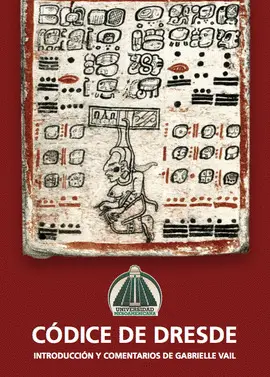
Códice de Dresde (Pasta Suave)

Códice de Dresde (Pasta Suave)

Universidad Mesoamericana

CÓDICE DE DRESDE es el séptimo librocon que la Universidad Mesoamericanapromueve el estudio, la comprensión yla valoración del pasado prehispánicomesoamericano y, en especial, de losconocimientos astronómicos, matemáticosy religiosos de los mayas.La Doctora Gabrielle Vail tradujo losglifos e incorporó explicaciones sobrelos cálculos astronómicos, calendáricos ymatemáticos que s...

Único ejemplar, sujeto
a consulta.

Q. 1.035

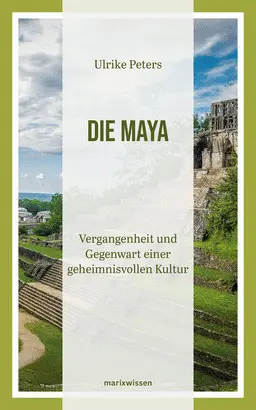
Die Maya: Vergangenheit Und Gegenwart Einer Geheimnisvollen Kultur

Die Maya: Vergangenheit Und Gegenwart Einer Geheimnisvollen Kultur

Ulrike Peters

Die Zivilisation der Maya ist eine der faszinierendsten Hochkulturen der Welt, die den Vergleich mit der Alten Welt nicht scheuen muss. Mit dem am weitesten entwickelten Schrift-, Zahl- und Kalendersystem waren sie die Genies unter den präkolumbianischen Kulturen. Sie kannten bereits die Null, eine Errungenschaft, die im Abendland erst mit dem arabischen Zahlsystem bekannt wurd...

Disponible

Q. 230

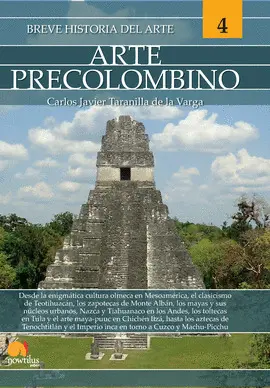
Breve Historia del Arte Precolombino

Breve Historia del Arte Precolombino

Taranilla De La Varga, Carlos Javier

Desde la enigmática cultura olmeca en Mesoamérica, el clasicismo de Teotihuacán, los zapotecas de Monte Albán, los mayas y sus núcleos urbanos, Nazca y Tiahuanaco en los Andes, los toltecas en Tula y el arte maya-puuc en Chichén Itzá, hasta los aztecas de Tenochtitlán y el Imperio inca en torno a Cuzco y Machu-Picchu. Con Breve historia del arte precolombino conocerá el desarro...

Único ejemplar, sujeto
a consulta.

Q. 285