0
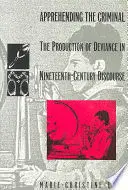
APPREHENDING THE CRIMINAL: THE PRODUCTION OF DEVIANCE IN NINETEENTH-CENTURY DISCOURSE

APPREHENDING THE CRIMINAL: THE PRODUCTION OF DEVIANCE IN NINETEENTH-CENTURY DISCOURSE

MARIE-CHRISTINE LEPS

Q. 430
IVA incluido
No disponible
Editorial:
DUKE UNIVERSITY
Año de edición:
1992
Materia:
Historia y Mitología
ISBN:
978-0-8223-1271-0
Páginas:
262
Q. 430
IVA incluido
No disponible
Añadir a favoritos

In this wide-ranging analysis, Marie-Christine Leps traces the production and circulation of knowledge about the criminal in nineteenth-century discourse, and shows how the delineation of deviance served to construct cultural norms. She demonstrates how the apprehension of crime and criminals was an important factor in the establishment of such key institutions as national systems of education, a cheap daily press, and various welfare measures designed to fight the spread of criminality.u003cbru003e Leps focuses on three discursive practices: the emergence of criminology, the development of a mass-produced press, and the proliferation of crime fiction, in both England and France. Beginning where Foucault's work u003ciu003eDiscipline and Punishu003c/iu003e ends, Leps analyzes intertextual modes of knowledge production and shows how the elaboration of hegemonic truths about the criminal is related to the exercise of power. u003cbru003e The scope of her investigation includes scientific treatises such as u003ciu003eCriminal Manu003c/iu003e by Cesare Lombroso and u003ciu003eThe English Convictu003c/iu003e by Charles Goring, reports on the Jack the Ripper murders in u003ciu003eThe Timesu003c/iu003e and u003ciu003eLe Petit Parisienu003c/iu003e, the Sherlock Holmes stories, Stevenson's u003ciu003eStrange Case of Dr. Jekyll and Mr. Hydeu003c/iu003e, and novels by Zola and Bourget.u003cbru003e This work will be indispensable to all readers interested in discourse analysis, and to scholars and students of literary and cultural studies, anthropology, criminology, nineteenth-century history, and interdisciplinary studies.u003cbru003e

Artículos relacionados

  • ÉRASE UNA VEZ TENOCHTITLÁN
    ÉRASE UNA VEZ TENOCHTITLÁN
    ROSAS, ALEJANDRO
    Aunque nos separan siete siglos, mexicas y chilangos compartimos un pasado común escrito sobre un lugar donde alguna vez hubo un lago. La historia de Tenochtitlán es el preludio de la historia de la Ciudad de México y ha llegado la hora de mirarla a través de sus dioses y tlatoanis. Este es un relato al más puro estilo de Game of Thrones, pero mexica y verídico, en el que, mie...
    Disponible

    Q. 190

  • RUSIA CONTRA EL MUNDO
    RUSIA CONTRA EL MUNDO
    MARC MARGINEDAS
    Más de dos décadas de terrorismo de Estado, secuestros, mafia y propagandaTras la caída de la Unión Soviética en 1991, Rusia era un país empobrecido y caótico que parecía destinado a la irrelevancia internacional. Pero bajo el liderazgo de Vladímir Putin, ha recuperado una influencia que desafía el orden global. ¿Qué sostiene este «imperio» que con los años ha derivado hacia el...
    Disponible

    Q. 170

  • LOS MÉDICOS DE AUSCHWITZ
    LOS MÉDICOS DE AUSCHWITZ
    BRUNO HALIOUA
    Un testimonio espeluznante sobre la actuación de los médicos para ejecutar la Solución Final en el más infame de los campos nazis del Tercer Reich.27 de enero de 1945. Las tropas soviéticas entran por primera vez en Auschwitz-Birkenau y descubren con horror el principal centro de exterminio del Tercer Reich. Sesenta mil prisioneros serán liberados a su llegada, pero allí quedar...
    Único ejemplar, sujeto
    a disponibilidad

    Q. 230

  • REINOS DESAPARECIDOS- 2025
    REINOS DESAPARECIDOS- 2025
    DAVIES, NORMAN
    Cuando pensamos en el pasado de Europa, pensamos en la historia de países que existen hoy -Francia, Inglaterra, España, Alemania, Rusia, etcétera.- Y los historiadores se suelen centrar en la historia de países que todavía perviven. Pero la historia de Europa está plagada de reinos, ducados, imperios y repúblicas ya desaparecidos que tuvieron un papel predominante en su tiempo:...
    Disponible

    Q. 410

  • UN PUEBLO EN EL TERCER REICH
    UN PUEBLO EN EL TERCER REICH
    JULIA BOYD / PATEL, ANGELIKA / BOYD, JULIA
    Los tentáculos del nazismo en la vida cotidiana Oberstdorf es un hermoso pueblo de los Alpes. Allí, durante siglos, las personas llevaron vidas sencillas, al margen de la gran historia. Sin embargo, incluso en este idílico pueblo, el nacionalsocialismo llegó a controlar la vida y la mente de sus habitantes. Basado en material de archivo, cartas, entrevistas y relatos orales, U...
    Disponible

    Q. 325

  • ¿QUIÉN TEME A LOS GRIEGOS Y A LOS ROMANOS?
    ¿QUIÉN TEME A LOS GRIEGOS Y A LOS ROMANOS?
    BETTINI, MAURIZIO
    Entre la cancelación y la veneración acrítica de los clásicos existe otro camino: el diálogo respetuoso pero sincero con un pasado que, aunque nos incomode, sigue siendo parte fundamental de quiénes somos.En las aulas de todo el mundo se están sometiendo a examen crítico los textos que hasta hace no tanto se consideraban los pilares sagrados de la civilización occidental. Los a...
    Disponible

    Q. 160

Otros libros del autor

  • APPREHENDING THE CRIMINAL: THE PRODUCTION OF DEVIANCE IN NINETEENTH-CENTURY DISCOURSE
    APPREHENDING THE CRIMINAL: THE PRODUCTION OF DEVIANCE IN NINETEENTH-CENTURY DISCOURSE
    MARIE-CHRISTINE LEPS
    In this wide-ranging analysis, Marie-Christine Leps traces the production and circulation of knowledge about the criminal in nineteenth-century discourse, and shows how the delineation of deviance served to construct cultural norms. She demonstrates how the apprehension of crime and criminals was an important factor in the establishment of such key institutions as national syst...
    No disponible

    Q. 1.490