Saltar al contenido principal
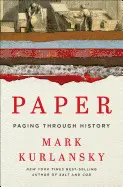
Paper
-15%

Paper

Mark Kurlansky

Paper is one of the simplest and most essential pieces of human technology. For the past two millennia, the ability to produce it in ever more efficient ways has supported the proliferation of literacy, media, religion, education, commerce, and art; it has formed the foundation of civilizations, promoting revolutions and restoring stability. One has only to look at history s gr...

Editorial:
Norton
Año de edición:
2016
ISBN:
978-0-393-23961-4
Páginas:
416
Encuadernación:
OTROS
Q. 280
Q. 238
IVA incluido
No disponible
Añadir a favoritos Avisar disponibilidad

Sinopsis

Paper is one of the simplest and most essential pieces of human technology. For the past two millennia, the ability to produce it in ever more efficient ways has supported the proliferation of literacy, media, religion, education, commerce, and art; it has formed the foundation of civilizations, promoting revolutions and restoring stability. One has only to look at history s greatest press run, which produced 6.5 billion copies of Mao zhuxi yulu, Quotations from Chairman Mao Tse-tung (Zedong) which doesn t include editions in 37 foreign languages and in braille to appreciate the range and influence of a single publication, in paper. Or take the fact that one of history s most revered artists, Leonardo da Vinci, left behind only 15 paintings but 4,000 works on paper. And though the colonies were at the time calling for a boycott of all British goods, the one exception they made speaks to the essentiality of the material; they penned the Declaration of Independence on British paper.
Now, amid discussion of going paperless and as speculation about the effects of a digitally dependent society grows rampant we ve come to a world-historic juncture. Thousands of years ago, Socrates and Plato warned that written language would be the end of true knowledge, replacing the need to exercise memory and think through complex questions. Similar arguments were made about the switch from handwritten to printed books, and today about the role of computer technology. By tracing paper s evolution from antiquity to the present, with an emphasis on the contributions made in Asia and the Middle East, Mark Kurlansky challenges common assumptions about technology s influence, affirming that paper is here to stay. Paper will be the commodity history that guides us forward in the twenty-first century and illuminates our times."

Artículos relacionados

100 Fragmentos del Mundo Clásico -15%

100 Fragmentos del Mundo Clásico

Hernández De La Fuente, David

Un compendio fascinante de mitos, leyendas y realidades históricas¿Existió la ciudad de la Atlántida? ¿Pronunció Julio César las famosas palabras «¿Tú también, hijo?», antes de morir? A veces, la narración patrimonial y literaria difiere de los hechos. Así, este libro, escrito con afán divulgativo, pretende transitar por la delgada línea roja que separa los relatos de tintes le...

Disponible
Q. 150

Q. 128

Érase una Vez Tenochtitlán -15%

Érase una Vez Tenochtitlán

Rosas, Alejandro

Aunque nos separan siete siglos, mexicas y chilangos compartimos un pasado común escrito sobre un lugar donde alguna vez hubo un lago. La historia de Tenochtitlán es el preludio de la historia de la Ciudad de México y ha llegado la hora de mirarla a través de sus dioses y tlatoanis. Este es un relato al más puro estilo de Game of Thrones, pero mexica y verídico, en el que, mie...

Único ejemplar, sujeto
a disponibilidad
Q. 190

Q. 162

Las Entrevistas de Núremberg -15%

Las Entrevistas de Núremberg

Goldensohn, Leon

Un documento único: la transcripción de las conversaciones que mantuvo Leon Goldensohn, psiquiatra del Ejército Estadounidense, con los principales encausados en el proceso de Núremberg. En 1946, con los juicios de Núremberg en marcha, el psiquiatra del ejército estadounidense Leon Goldensohn recibió el encargo de entrevistar a dos docenas de líderes alemanes encausados, así co...

Disponible
Q. 390

Q. 332

Las Mujeres que Empuñaron la Espada -15%

Las Mujeres que Empuñaron la Espada

Bendriss, Ernest Y.

Guerreras olvidadas. Heroínas silenciadas. Durante siglos, la historia de la guerra ha sido contada de forma casi exclusiva en masculino. Pero desde los campos de batalla de la Antigüedad hasta las trincheras de la Segunda Guerra Mundial, miles de mujeres empuñaron armas, lideraron ejércitos y combatieron en primera línea, ignorando los roles que sus tiempos les imponían. Un vi...

Disponible
Q. 275

Q. 234

El Temperamento Revolucionario -15%

El Temperamento Revolucionario

Darnton, Robert

¿Qué llevó a Francia a la Revolución? Un ensayo excepcional sobre el temperamento responsable de cambiar el curso de la Historia. «Este libro es, sencillamente, un festín que, gracias a su magnífica narración, es fácil de digerir». Gerard de Groot, The Times Cuando una multitud asaltó la Bastilla en julio de 1789, se cerró una etapa histórica y nació un mundo nuevo. La mayoría ...

Disponible
Q. 470

Q. 400

Fernando el Católico -15%

Fernando el Católico

Belenguer, Ernest

La cara oculta, tras la larga sombra de Isabel, del reinado que reconfiguró el mapa político del mundo e inauguró el Renacimiento.En 1469, Isabel I de Castilla y Fernando II de Aragón contrajeron matrimonio tras firmar las Capitulaciones de Cervera, mucho más favorables para Isabel que para Fernando. De alguna manera, el espíritu de ese acuerdo ha llegado hasta la historiograf...

Disponible
Q. 200

Q. 170