Saltar al contenido principal
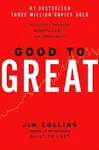
Good To Great
-10%

Good To Great

Why Some Companies Make The Leap And Others Dont

Jim Collins

The Challenge Built to Last, the defining management study of the nineties, showed how great companies triumph over time and how long-term sustained performance can be engineered into the DNA of an enterprise from the verybeginning.But what about the company that is not born with great DNA? How can good companies, mediocre companies, even bad companies achieve enduring greatnes...

Editorial:
Collins
Año de edición:
2001
ISBN:
978-0-06-662099-2
Páginas:
300
Encuadernación:
CARTONÉ / HARDCOVER
Q. 360
Q. 324
IVA incluido
Disponible
Añadir a favoritos

Sinopsis

The Challenge Built to Last, the defining management study of the nineties, showed how great companies triumph over time and how long-term sustained performance can be engineered into the DNA of an enterprise from the verybeginning.

But what about the company that is not born with great DNA? How can good companies, mediocre companies, even bad companies achieve enduring greatness?

The Study For years, this question preyed on the mind of Jim Collins. Are there companies that defy gravity and convert long-term mediocrity or worse into long-term superiority? And if so, what are the universal distinguishing characteristics that cause a company to go from good to great?

The Standards Using tough benchmarks, Collins and his research team identified a set of elite companies that made the leap to great results and sustained those results for at least fifteen years. How great? After the leap, the good-to-great companies generated cumulative stock returns that beat the general stock market by an average of seven times in fifteen years, better than twice the results delivered by a composite index of the world's greatest companies, including Coca-Cola, Intel, General Electric, and Merck.

The Comparisons The research team contrasted the good-to-great companies with a carefully selected set of comparison companies that failed to make the leap from good to great. What was different? Why did one set of companies become truly great performers while the other set remained only good?

Over five years, the team analyzed the histories of all twenty-eight companies in the study. After sifting through mountains of data and thousands of pages of interviews, Collins and his crew discovered the key determinants of greatness -- why some companies make the leap and others don't.

The Findings The findings of the Good to Great study will surprise many readers and shed light on virtually every area of management strategy and practice. The findings include: Level 5 Leaders: The research team was shocked to discover the type of leadership required to achieve greatness. The Hedgehog Concept (Simplicity within the Three Circles): To go from good to great requires transcending the curse of competence. A Culture of Discipline: When you combine a culture of discipline with an ethic of entrepreneurship, you get the magical alchemy of great results. Technology Accelerators: Good-to-great companies think differently about the role of technology. The Flywheel and the Doom Loop: Those who launch radical change programs and wrenching restructurings will almost certainly fail to make the leap.

"Some of the key concepts discerned in the study," comments Jim Collins, "fly in the face of our modern business culture and will, quite frankly, upset some people."

Perhaps, but who can afford to ignore these findings?

Artículos relacionados

Unreasonable Hospitality: The Field Guide -10%

Unreasonable Hospitality: The Field Guide

Guidara, Will

From the New York Times bestselling author, former co-owner of the #1 restaurant in the world, and co-producer of the Emmy Award-winning series The Bear comes the much-awaited interactive guide to putting the principles of Unreasonable Hospitality into action in your organization.With over one million copies sold to date, Will Guidara's book Unreasonable Hospitality issued a co...

Disponible
Q. 260

Q. 234

Open To Work -10%

Open To Work

Ryan Roslansky / Aneesh Raman

Work is changing for everyone, everywhere. Standing still isn't an option. Ryan Roslansky and Aneesh Raman, CEO and Chief Economic Opportunity Officer at LinkedIn, show you how to take control of this moment with clarity and confidence. The future of work is not a distant horizon. It is being built right now. While some of us are experimenting and adapting with AI, most of us a...

Disponible
Q. 235

Q. 212

The Money Habit -10%

The Money Habit

Mike Michalowicz

Money. What if you never had to worry about it again?In the follow-up to his international bestseller Profit First, entrepreneur and money expert Mike Michalowicz reveals how to achieve financial freedom by working with your natural habits rather than trying to change them. His Profit First model has already helped over a million businesses and entrepreneurs achieve financial i...

Disponible
Q. 310

Q. 279

Do More In Four -10%

Do More In Four

Joe O'connor / Jared Lindzon

An impassioned--and data-driven--case for a four-day workweek. The five-day workweek is a pillar of modern life, but it isn't backed by science, ancient wisdom, or divine decree. It's simply a relic of the industrial age--and it's time for an upgrade. What if we could accomplish more while working fewer days? A shortened workweek once seemed like a radical idea. Today, it's emb...

Disponible
Q. 295

Q. 266

Powered By Projects -10%

Powered By Projects

Nieto-Rodriguez, Antonio

Rewire your organization--and your leadership--for a world driven by projects. It's time to stop treating projects as side work. In the age of constant transformation, projects are the primary way organizations create value and accelerate innovation. In this new paradigm--the project economy--traditional agile approaches are no longer enough. The next evolution is the project-d...

Disponible
Q. 330

Q. 297

The Transformation Economy -10%

The Transformation Economy

Pine, B. Joseph

From the author who defined the Experience Economy comes the next big shift: the Transformation Economy. A fundamental economic shift is emerging. Goods, services--even memorable experiences--are no longer enough to attract and keep your customers. Customers are clamoring to change, eager to reach their aspirations and to become better versions of themselves. Welcome to the Tra...

Disponible
Q. 330

Q. 297

Otros libros del autor

Good To Great (Edición en Español) -10%

Good To Great (Edición en Español)

Jim Collins

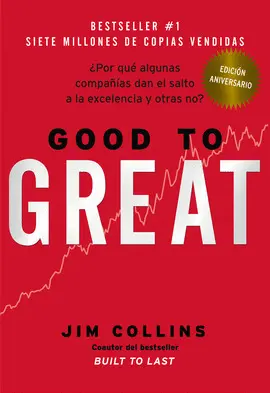
¿Por qué algunas compañías dan el salto a la excelencia y otras no? Referenciado como uno de los diez mejores libros sobre gestión empresarial, "Good to Great" nos ofrece todo un conjunto de directrices y paradigmas que debe adoptar cualquier empresa que pretenda diferenciarse de las demás. Después de revisar montañas de datos, de hacer miles de entrevistas y de utilizar rigu...

Disponible
Q. 210

Q. 189

Girando la Rueda -10%

Girando la Rueda

Jim Collins

Una guía indispensable que complementa el libro "Good to Great", el número uno de los best-sellers de empresa. La obra se centra en la aplicación del concepto de "rueda o volante de inercia", una de las ideas más reconocidas de Jim Collins y que está siendo empleada en todas las industrias y sectores sociales, así como por las startups. La clave del éxito empresarial no respo...

Disponible
Q. 160

Q. 144

Estuche Good To Great + Girando la Rueda -10%

Estuche Good To Great + Girando la Rueda

Jim Collins

Este estuche contiene el libro "Good to Great", referenciado como uno de los diez mejores libros sobre gestión empresarial, junto con su complemento indispensable, "Girando la Rueda". Entre las páginas de "Good to Great" encontramos los determinantes clave de la excelencia empresarial que Collins y su equipo de investigación identificaron como cruciales en el salto que un conju...

No disponible
Q. 310

Q. 279

Turning The Flywheel -10%

Turning The Flywheel

Jim Collins

u003cpu003eA companion guidebook to the number-one bestselling Good to Great, focused on implementation of the flywheel concept, one of Jim Collins' most memorable ideas that has been used across industries and the social sectors, and with startups.u003cbru003eu003cbru003eThe key to business success is not a single innovation or one plan. It is the act of turning the flywheel, ...

No disponible
Q. 160

Q. 144

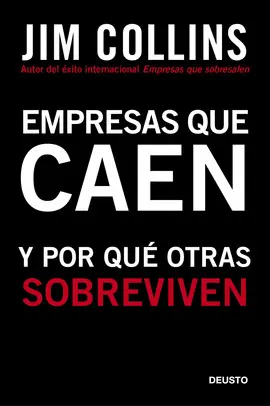
Empresas que Caen -10%

Empresas que Caen

Jim Collins

El declive se puede detectar. El declive se puede evitar. El declive se puede revertir. Jim Collins es probablemente el académico más reconocido del mundo de la empresa y del management. Trabajó durante cinco años en Empresas que sobresalen que, publicado en 2001, se convirtió rápidamente en un éxito internacional. Los críticos siguen considerándolo el mejor libro de manageme...

No disponible
Q. 310

Q. 279

Turning Goals Into Results: The Power Of Catalytic Mechanisms -10%

Turning Goals Into Results: The Power Of Catalytic Mechanisms

Jim Collins

Most executives have a big, hairy, audacious goal. But they install layers of stultifying bureaucracy that prevent them from realizing it. In this article, Jim Collins introduces the catalytic mechanism, a simple yet powerful managerial tool that helps turn lofty aspirations into reality. The crucial link between objectives and results, this tool is a galvanizing, nonbureaucrat...

No disponible
Q. 105

Q. 95

Otros clientes también compraron

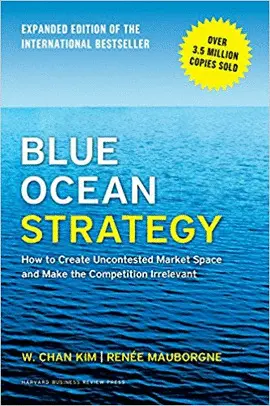
Blue Ocean Strategy, Expanded Edition -10%

Blue Ocean Strategy, Expanded Edition

Mauborgne, Renée / Kim, W. Chan

The global phenomenon that has sold 3.6 million copies, is published in a record-breaking 44 languages and is a bestseller across five continents?now updated and expanded with new contentIn this perennial bestseller, embraced by organizations and industries worldwide, globally preeminent management thinkers W. Chan Kim and Renée Mauborgne challenge everything you thought you kn...

Disponible
Q. 330

Q. 297